🌱 David Kolb’s Experiential Learning Theory
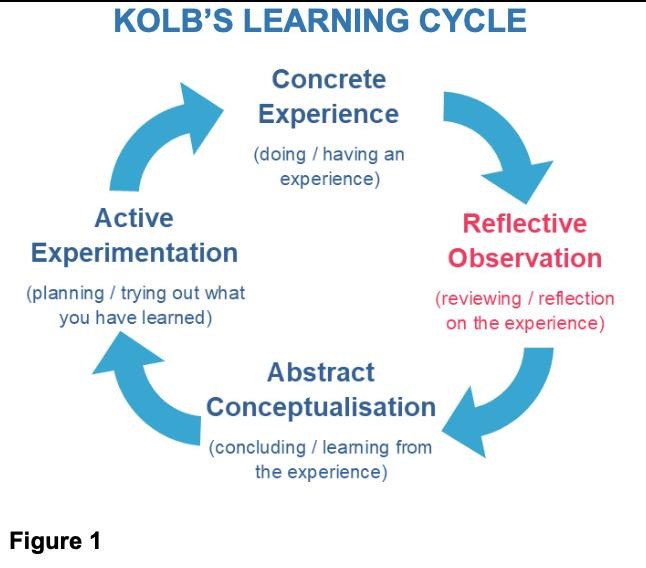
David A. Kolb proposed that learning is a continuous process in which knowledge is created through the transformation of experience.
In simple words:
“We learn by doing, reflecting, understanding, and trying again.”
Kolb described learning as a 4-stage cycle:
1. 🟢 Concrete Experience — DO
The learner actually experiences something.
Examples:
Participating in a role play
Handling a difficult customer
Playing a team-building game
Communicating with a senior
Managing a simulated emergency situation
Trainer asks:
What happened?
What did you experience?
What did you do?
2. 🔵 Reflective Observation — THINK
After the activity, participants reflect on what happened.
They observe:
What went well?
What went wrong?
How did I feel?
How did others react?
What could I have done differently?
Trainer asks:
“What did you notice during the activity?”
This is where a simple activity becomes a learning experience.
3. 🟡 Abstract Conceptualization — LEARN
Participants now connect their experience with a concept, principle, theory, or framework.
For example, after a communication role play, the trainer introduces:
Effective Communication =
Active listening
Clarity
Appropriate tone
Empathy
Non-verbal communication
Feedback
The participant thinks:
“Now I understand WHY my communication created that reaction.”
4. 🔴 Active Experimentation — APPLY
Participants take the learning and try it in a new situation.
For example:
First attempt:
Employee speaks aggressively to a colleague.
After learning about assertive communication:
Second attempt:
Employee communicates the same concern calmly and assertively.
The learner asks:
“How can I use what I learned next time?”
🔄 The Complete Kolb Cycle
You can remember it very simply:
DO → THINK → LEARN → APPLY → DO AGAIN
Stage Simple Meaning Training Example
Concrete Experience DO Communication role play
Reflective Observation THINK Discuss what happened
Abstract Conceptualization LEARN Teach communication principles
Active Experimentation APPLY Repeat role play differently
And then the cycle continues.
🎯 Example for Your Workplace Communication Training
Suppose you are conducting a session on:
“How to Communicate Effectively with Seniors and Colleagues”
Step 1 – DO
Give participants this situation:
“Your senior has given you an urgent task, but you already have three important assignments.”
Ask two participants to role-play the conversation.
Step 2 – THINK
Ask the group:
What did the employee say?
What was the tone?
How did the senior react?
Was the employee passive, aggressive or assertive?
What could have been done better?
Step 3 – LEARN
Now introduce:
ASSERTIVE COMMUNICATION
Teach participants:
I understand + I explain + I suggest + I seek clarity
Example:
“I understand that this task is urgent. I am currently working on the monthly report and the client documentation. Could you please help me prioritise which task should be completed first?”
Step 4 – APPLY
Ask the same participants to repeat the role play using assertive communication.
Now they can experience the difference.
That's experiential learning.
 September 02, 2026